



Happy Black August!
We have entered the month dedicated to honoring the fallen freedom fighters within the Black Revolution to call for the release of political prisoners in the United States, to condemn the oppressive conditions of U.S. prisons, and to emphasize the continued importance of the Black Liberation struggle. With the principles being: Study, Fast, Train, Fight.1
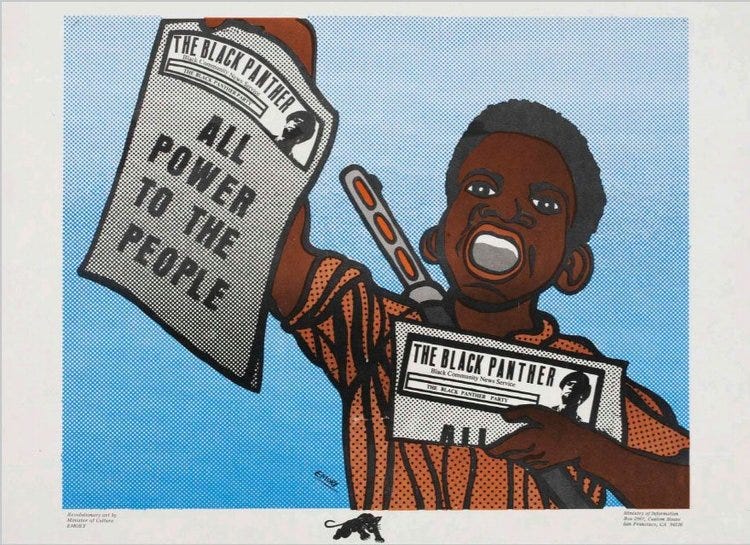
I personally use Black August to celebrate African countries who gained independence during this month; with the majority being a part of The Year of Africa (1960)2. When it comes to the history of liberation struggles during the 1960s and 1970s Black people were in a global struggle towards liberation from South Africa to the America’s.
Now, to the point of this article:
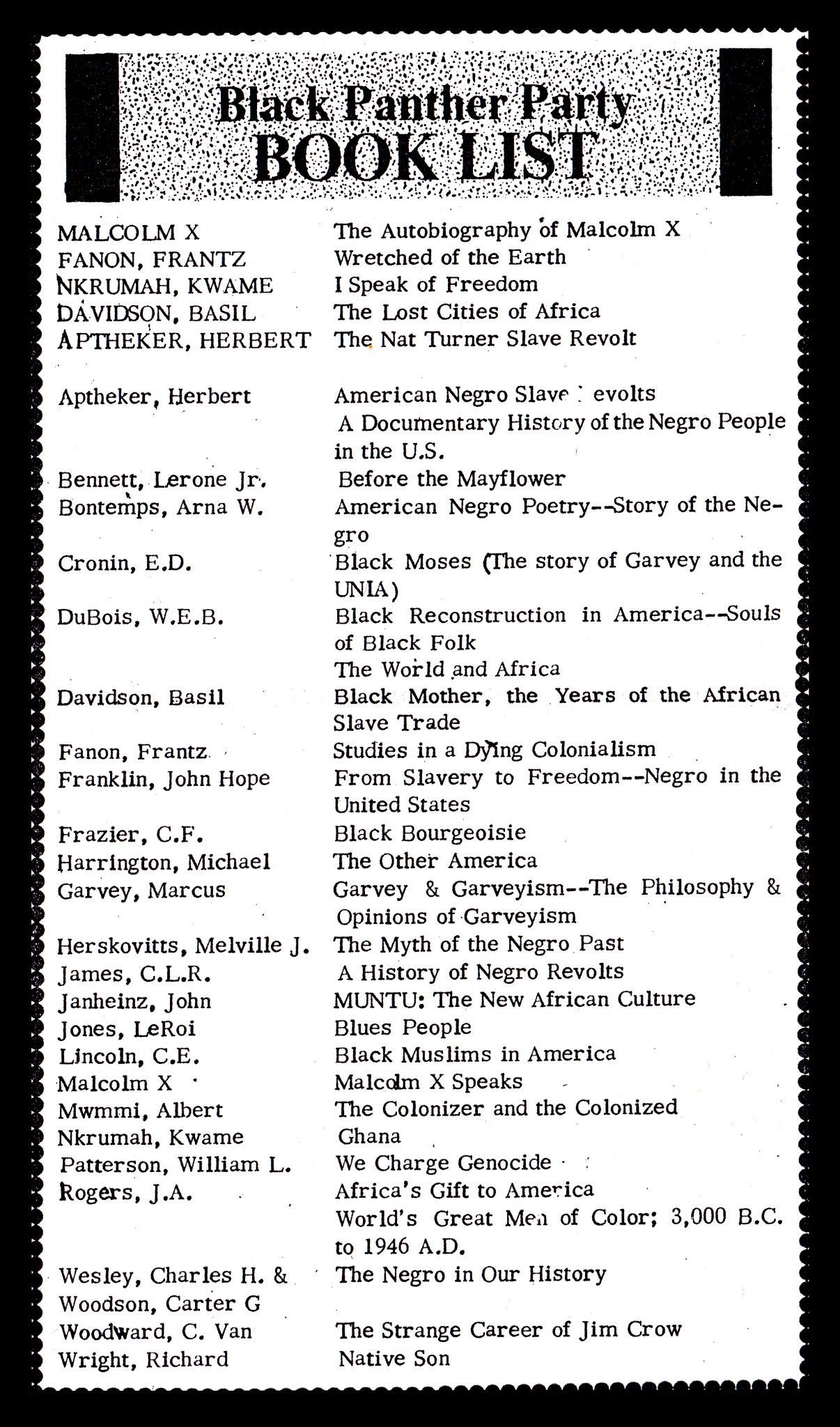
One of the requirements of being within the Black Panther Party3 involved literacy. Those in the party were expected to read up to two hours a day and even now, the books listed below are considered the blueprint for radical reading.
Yet, as a Black woman in America, I see that women within the revolution are missing. Black revolutions did not start and end with North America. The heart of it is in Africa, the Caribbean, and Brazil. I do not aim to dismiss the books originally chosen for this list; I only want to extend it. I collaborated with my fellow comrades for suggestions and translations.
MARIA FIRMINO DE REIS (Founding Mother of Afro Brazilian Lit)
1. “Ursula”
1. “Ponciá Vivêncio”
1. Por um Feminismo Afro-Latino-Americano [Towards an Afro-Latin-American Feminism]
2. Lugar de Negro; [Black People’s Place]
1. Uma história feita por mãos negras [A history made by black hands]
2. O negro visto por ele mesmo. [The Black seen by himself]
The Dialect is in the Sea: Collected writings by one of the most influential Black Brazilian intellectuals of the twentieth century
1. “Quarto de Despejo” [Child of the Dark]
Dispositivo de Racialidade; [Race Apparatus(?)]
In this book, Sueli manages the concept of dispositif (in Brazilian translation, dispositivo; in English translation, as far as I could see, apparatus) by Michel Foucault to understand how it is employed in terms of race.
She is a renowned philosopher in here, and also is the founder of Geledés, the black women institute in Brazil: https://www.geledes.org.br/
Tornar-se negro. [To become black]
This is a work by a black psychiatrist and psychoanalyst. She was one of the firsts to study psychiatry and psychoanalysis here in relation to race.
O pacto da branquitude. [The whiteness treat]
It is an interesting work, regarding that it’s a black woman “studying white people” (or the white structures of power), sort of reversing the historical roles, if we put it that way, of white people always treating black people of subjects (theme) of study but never as subjects (people) of humanity. It reminds of The Souls of White Folk, the essay by Du Bois which makes a genius reversal of the title The Souls of Black Folk; and also reminds me of Psicopatologia social do ‘branco’ brasileiro [Psychopathology of the Brazilian ‘White’], by Guerreiro Ramos. Branquitude [“Whiteness”] is now a concept here that is being studied by a number of sociologists and anthropologists etc.
“A cor do inconsciente”
This is a recommendation by a friend of mine; I have no notes to add on this one except that it is another work focused on psychology, black subject etc.
1. Sociologia do Negro Brasileiro;
2. Dialética Radical do Brasil Negro;
3. Rebeliões da Senzala;
The most important trait of Clovis Moura is that he allied black thought with the marxist tradition. He looked at Brazil’s black struggle through marxist lenses, and some people say he was the best in this reading of Brazil’s history. Rebeliões da Senzala is important because of the context: it was being spread that the enslaved people in here accepted slavery peacefully, and that the Portuguese colonizer was a bit more generous; but in this book he intends to re-read the “official history” and propose a new view on how the enslaved people not only did not accepted it peacefully but in fact did revolt against it in a lot of historical events. It may be compared to Black Jacobins by C.L.R James, in this sense, I suppose.
1. Negro Sou. [I am Black]
There can be some similarities between him and Fanon regarding the “dialectical affirmation of blackness”. Although he was not a revolutionary like Fanon, in the marxist (?) sense of the word.
ABDIAS NASCIMENTO:
1. Quilombismo: Documentos de uma militância pan-africanista;
2. O Genocídio do Negro Brasileiro;
He was one the firsts to accept Brazilian blackness and fight for it. Some parts of his works are bound to criticism (he had a very short-sighted view of marxism regarding its relation to black struggle; although I know, of course, that neither we shall have some dogmatics views on Marx). He was also founder of the TEN: Teatro Experimental do Negro (Black Experimental Drama) and a painter. I like him very much and stay aware of some limitations of his work nonetheless.
In literature, the most notorious, recent case is, I think, Um Defeito de Cor. The book length is about 950 pages. I’m not sure if there’s any English translation. All I know is that Ana Maria Gonçalves, the author (she is lovely, I wish you could see some of her interviews; don’t know if they have English subtitles), spent some time in Louisiana, New Orleans and the time she spent there was very important to her understanding of herself as a Black woman. For, as you could see reading Beatriz Nascimento, Blackness in Brazil is profoundly rejected and denied. There’s a “racial democracy myth” which makes us think that there’s no racism here. That is, when she went to spend some time in the U.S. she finally could recognize herself as a Black woman and explore that. She is a big fan of Toni Morrison.
Other classic authors in here: Machado de Assis and Lima Barreto. But “Black literature” in Brazil is not the same thing as it is in the U.S. Blackness sometimes in those classic authors (because of the “racial democracy mith” or the denial of blackness) are present in very subtle, ambiguous way. We need to read between the lines, and there is a book dedicated to that specifically being released now. It’s a biography that understands Machado de Assis as a black author and searches in his work the discreet ways of him exploring blackness.
*Thank you Miguel Fernandes for your contribution and commentary to assist those in order to further their research
Peru
Victoria Santa Cruz
Africa
Chimamanda Ngozi Adichie—We Should All be Feminists (Nigeria)
Patricia Jabbeh Wesley—African Poetry Series: Collected Poetry (1998-2020) (Liberia)
George Padmore—Pan Africanism or Communism (Liberia)
Souleymane Bachir Diagne—The Ink of the Scholars: Reflections on Philosophy in Africa (Senegal)
Awa Thiam—Speak Out, Black Sisters (Senegal)
Sekou Ture—Women in Society (Guinea)
Kwame Nkrumah—Class Struggle in Africa (Ghana)
“The Black Power movement in the U.S.A., and the struggles of peoples of African descent in the Caribbean, South America and elsewhere, form an integral part of the African politico-military revolutionary struggle. Our victory will be their victory also, and the victory of all the revolutionary, oppressed and exploited masses of the world who are challenging the capitalist, imperialist and neo-colonialist power structure of reaction and counter-revolution.”
-Kwame Nkrumah
Thomas Sankara—Women’s Liberation and the African Freedom Struggle (Burkina
Faso)
Yvonne Vera—The Stone Virgins (Zimbabwe)
Agostinho Neto—Sacred Hope (Angola)
Ngũgĩ wa Thiong'o—A Writer’s Prison Diary (Kenya)
Amílcar Cabral—Unity & Struggle (Bissau-Guinea and Cape Verde)
Kenneth Kaunda— Zambia Shall be Free (Zambia)
United States of Amerika
Angela Davis—Women, Race, & Class
Eldridge Cleaver—Soul on Ice
Assata Shakur—Assata: An Autobiography
Marc A Hertzman—After Palmares: Diaspora, Inheritance, and the Afterlives of Zumbi
Sarah Trembath—This Past was Waiting for Me
Maya J. Berry—Defending Rumba in Havana
James Forman—Twenty Enemies
Erik S. McDuffie—The Second Battle for Africa
George Jackson—Blood in My Eye
Huey P. Newton—Revolutionary Suicide
Michelle Alexander—The New Jim Crow
Alice Walker—In Search of Our Mother’s Gardens
Donna Jean Murch—Living For the City: Migration, Education, and the Rise of the Black Panther Party in Oakland, California
Isabel Wilkerson—The Warmth of Other Suns
Sam Greenlee—The Spook Who Sat by the Door
Elaine Brown—A Taste of Power
Aja Monet—My Mother was a Freedom Fighter
Howard W. French—Born in Blackness
Mary Frances Phillips—Black Panther Woman: The Political and Spiritual Life of Ericka Huggins
The Young Lords: Johanna Fernandez
Caribbean
Aimé Césaire—Discourse on Colonialism (Martinique)
Patrick Chamoiseau—Texaco (Martinique)
Michel-Rolph Trouillot—Haiti: State Against Nation (Haiti)
Maryse Condé—Segu (Guadeloupe)
Jamaica Kincaid— A Small Place (Antigua)
George Lamming—The Castle of my Skin (Barbados)
Afua Cooper—Memories Have Tongue (Jamaica)
Maurice Bishop—In Nobody’s Back Yard (Speeches 1979-1983): A Memorial Volume (Grenada)
**This is an extensive list and I’ve added PDF’s (samples and/or completed texts) to the books l was able to find. A huge thanks all of those who suggested books old and new released alike. I wouldn’t have been able to do this without you!
***In addition to adding women to the list, I would like to honor Afro•Puerto Rican Denise Oliver-Velez, who’s 79th birthday would have been today, Aug. 1st, but she passed away on July 15th. Consider reading this article to learn more about her life.
Also, according to recent reports Afro•Dominican activist and historian Johanna Fernandez, author of ‘The Young Lords’, has also passed away. She studied Denise Oliver-Velez, the BPP, and The Young Lords extensively.
https://liberationschool.org/study-fast-train-fight-the-roots-of-black-august/
https://origins.osu.edu/article/year-of-africa-1960-rumba-pan-africanism-Kariba
https://nmaahc.si.edu/explore/stories/black-panther-party-challenging-police-and-promoting-social-change


I’m honored that Afro-Reads asked me for book suggestions to add to this extensive list of Afro-Literature. I must admit that I have learned more about the Afro-literature outside of the continental US by reading her work and suggestions than I have from reading anyone else’s reviews or comments.
I am hyped and jazzed by her efforts and those of so many other young members of the African Diaspora that seek dialogue across all regional boundaries through this vast network of literature. May we all read and listen to each other.
So good to honor Denise Oliver-Velez, who I met on Twitter. Puerto was her heart. I so enjoyed Victoria? "I am a Black Woman". ... no more straightening her hair. Thank u so much . I saw some books I want to read and will save this read. Again thank u very very much.